
Current Projects
Our research
We study osteoimmunology, an interdisciplinary field studying interactions between bone and the immune system, pairing mechanistic work in mice with translational research in people.
Mechanistic — in mice
Using “dirty” mice to redefine osteoporosis pathogenesis
Nearly all biomedical research runs on specific-pathogen-free (SPF) mice, which are immunologically naïve (like a newborn!). So-called ‘dirty’ mice — generated with natural microbial exposures (NME) derived from wild or pet-store mice — instead carry mature, chronically activated immune systems that mirror the human immune experience.
Bone and the immune system are deeply intertwined in bone marrow, where immune cells are generated. We treat osteoporosis as an immune-mediated disease, and we’re investigating whether the dirty mouse model can recapitulate naturally occurring human bone loss, as in post-menopausal osteoporosis.
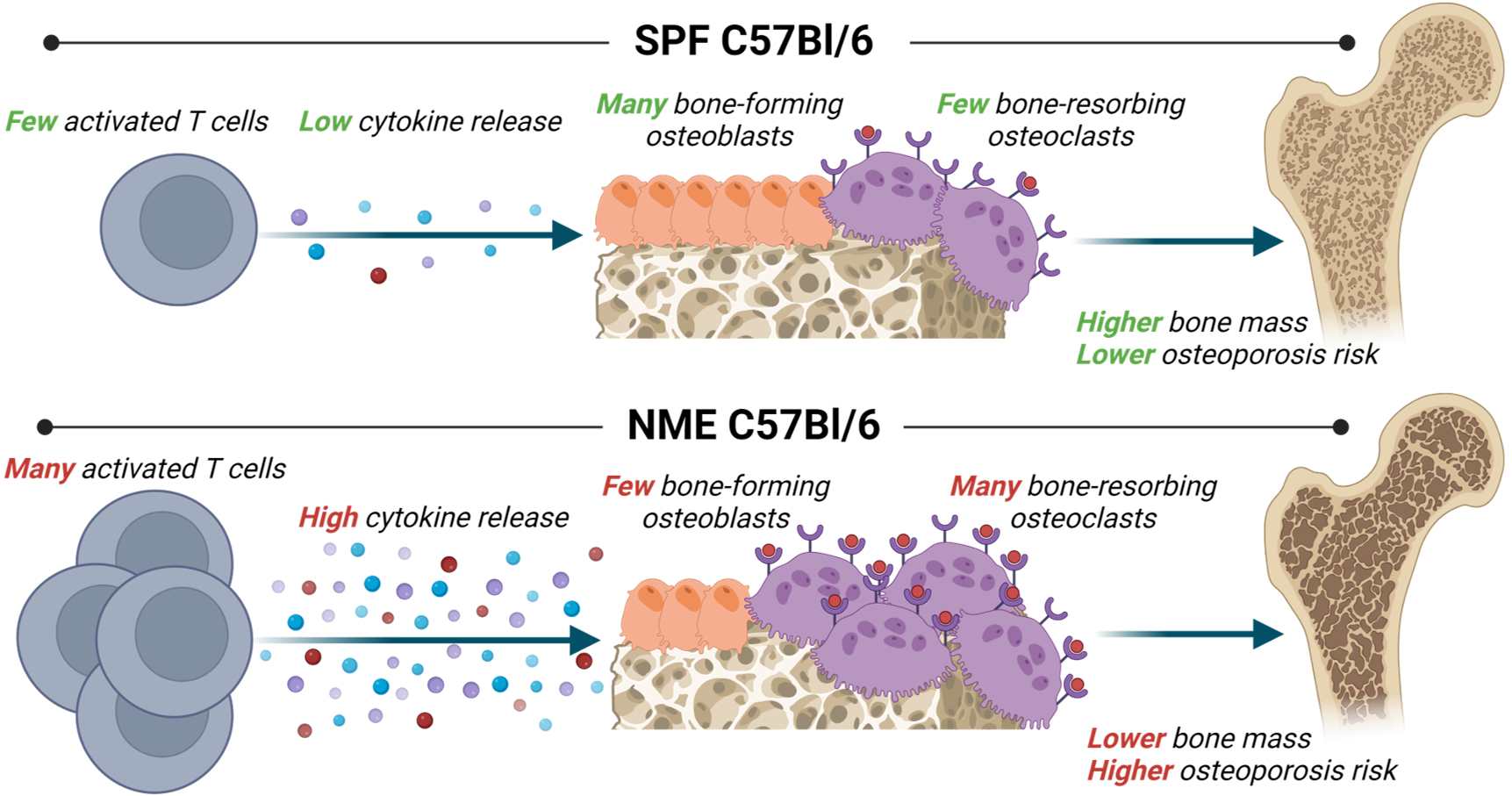
Over a longer horizon, we ask how the human skeleton evolved its fragility in the first place. The premise and its evolutionary backstory are laid out in Little-Letsinger & Hamilton 2023.
This work is ongoing and deliberately collaborative — if you work with dirty mice, or want to, email s.little@austin.utexas.edu.
Translational — in people
BoneFIT — bone health for the public
BoneFIT is a new initiative launching with the Fitness Institute of Texas (FIT) at UT Austin that brings bone health directly to the community. It offers two things to the public:
Bone density scans
DXA, the clinical standard for measuring bone mineral density, now available direct to the public.
Bone FIT training
A structured exercise program built to strengthen bone, based on the clinically proven LIFTMORE program.
Beyond the service itself, BoneFIT creates a real-world population in which to study whether bone loading programs proven to treat osteoporosis and improve bone mineral density and strength can succeed outside of the clinic. In the long-term, we hope to work in tandem with BoneFIT to translate the lab’s mechanistic findings into evidence-based prevention.